




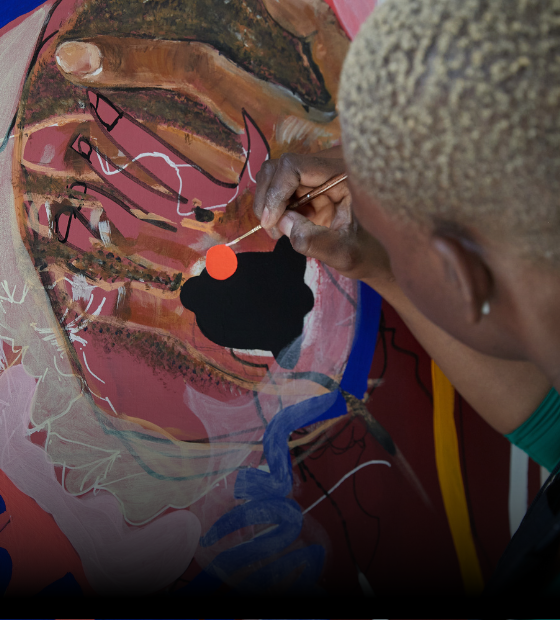

“The color of blood.” “My favorite deep rose.” “The coolest crimson.” Quinacridone crimson summons up instant emotional response. Sheer, vibrant and high impact, this single-pigment red has a blue undertone and exceptional longevity.
Made with pigment PV19, pigment violet 19, (often called quinacridone rose or quinacridone violet), quinacridone crimson is from the synthetic quinacridone family, which gives us a spectrum of colors from yellow, through to orange, red and violet. These all have a high-performance mix of high strength color and great transparency.
THE ORIGINS
Where does it come from? The quinacridone pigments are synthesized in the lab. First noticed as a by-product of chemical research in 1896, its potential wasn’t fully recognized until 1955 when W. Struve, a chemist at the DuPont company, saw the possibilities and went on to mass produce it. Once a commercial method of synthesizing quinacridone pigment was developed, our sister brand Winsor & Newton were one of the first to make quinacridone colors for artists. Its stability, lightfastness and color consistency quickly made it a useful alternative to the intensely hued but quick-fading alizarin reds.
How does it differ from the other quinacridone reds? Particle size determines the exact hue of a quinacridone pigment, as well as small differences in the crystalline structure of its molecules. A latticed structure makes a pinky-red, while a more linear structure gives more of an orange hue.
How is it made? In the color lab, chemists take two pairs of oxygen and nitrogen atoms grouped in sets of five rings of carbon linked together. This is the “quin” part of the name and gives the basic structure. To achieve each color, the chemists adjust the chemical composition. Each has a unique set of molecules that create a specific pigment through dispersion. The result is a non-toxic, sheer pigment that in acrylic paints can mix extremely well with other colors.
WHERE IS IT USED?
It was first manufactured at Walker-upon-Tyne and was sold as Turner’s Patent Yellow, with a company called C. Chaptal then setting up a manufacturing site in Montpellier, France. The pigment became popular with artists for being durable and bright, working well in oil and watercolor, but it was also unstable: blackening over time and in sunlight. A historic sample of the pigment from a wheelwright’s shop can be found in Hertford Museum in the UK. It takes the form of heavy, crumbly lumps, 1cm thick, which are dark on the outside, bright yellow inside. The artist would grind these himself to make up his paint. As well as coach decorations, Turner’s yellow was commonly used in domestic house paint and it was used to deccan be traced to the exotic, multi-colored scheme at Brighton Pavilion in England. By the early 19th century, the pigment was eventually superseded by chrome yellow, a more reliable color for artists to work with. Hurst, writing in 1904, comments that the color was “at one time largely used; but since the introduction of the chrome yellows, it has been gradually, and, perhaps, entirely abandoned”.
HOW TO USE IT
Quinacridone crimson is a super versatile addition to any creative’s palette. Liquitex makes it in a wide range of formats so you can take it from thick to thin, and experiment with a range of mediums.
Quinacridone crimson’s undertone is not quite as blue as alizarin crimson’s but has a cool quality that works well in all kinds of contexts. Deeper than its Liquitex sibling quinacridone red, it’s ideal for portraiture, creating glowing skin tones and realistic shadows. Mix it with white for a vibrant, blue-based deep rose pink or try it with a metallic or iridescent paint or medium to uncover multiple facets of under and masstone color. It creates all kinds of interesting purples and natural oranges - add a dash of phthalo green or marine blue and see where it takes you.
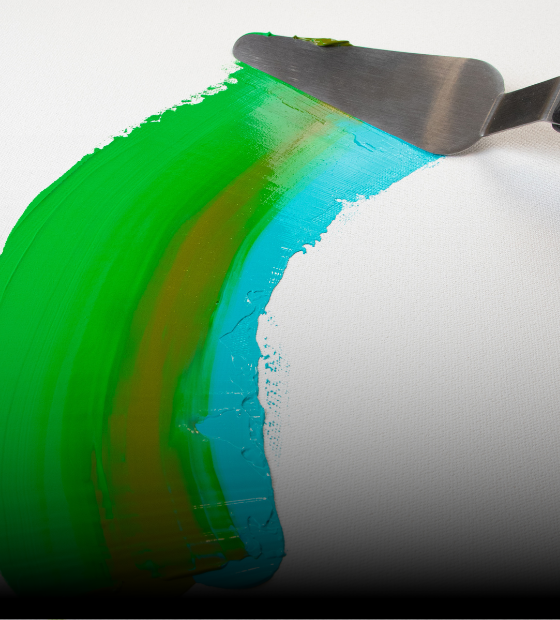
Quinacridone crimson lends itself well to a range of techniques and surfaces. Being transparent, it’s useful for color washes, staining and glazing. Combine it with our Pro Glass Medium for seriously incandescent results on transparent glassware. Or play around with texture and mix it with our Pro Glass Beads effects medium for undulating, sheer, glossy results.
Find Quinacridone crimson in Liquitex Heavy Body, Bio-Based Heavy Acrylic, Soft Body, Acrylic Marker and Spray Paint.
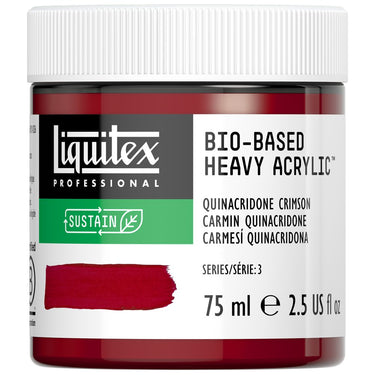
![LQX BIO-BASED HEAVY ACRYLIC QUINACRIDONE CRIMSON [SWATCH]](http://www.liquitex.com/cdn/shop/files/135785_375x375_crop_center.jpg?v=1762459047)
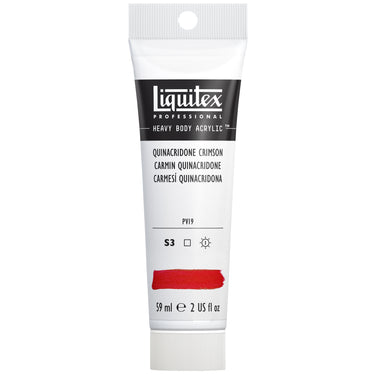


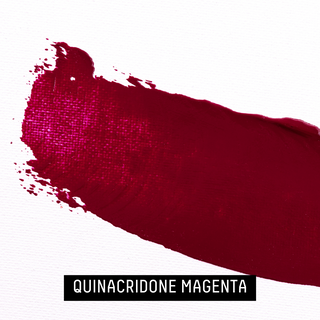


![LQX BASICS 24X22ML PAINT SET 887452028543 [FRONT]](http://www.liquitex.com/cdn/shop/files/80833_375x375_crop_center.jpg?v=1762458732)
![LQX ACRYLIC MARKER SET 6X 2-4MM CLASSICS [CONTENTS] 887452001225](http://www.liquitex.com/cdn/shop/files/68762_375x375_crop_center.jpg?v=1707320720)


![LQX BASICS 6x118ML SET 887452059226 [SET WITH CONTENTS 2]](http://www.liquitex.com/cdn/shop/files/130398_375x375_crop_center.jpg?v=1707324060)
![LQX BASICS 6x118ML SET 887452059226 [FRONT]](http://www.liquitex.com/cdn/shop/files/130396_375x375_crop_center.jpg?v=1762458768)
![LQX MATTE POURING MEDIUM SET [CONTENTS] 887452048695 [NA]](http://www.liquitex.com/cdn/shop/files/96237_375x375_crop_center.jpg?v=1762458531)